 |
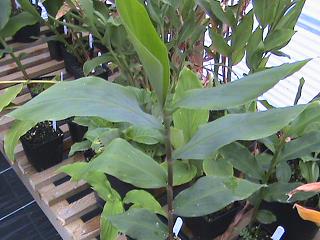
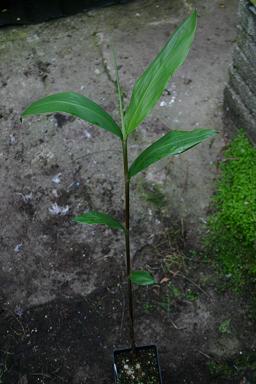
Zingiber zerumbet is a common, vigorous and easily available ginger. Sadly it is also rather too tropical for use in the UK.
Some of the forms of Zingiber zerumbet have been shown to tolerate some cold - unfortunately this is one of the more tropical forms, and needs a lot of heat in the spring to get it going.
I can get it through the winter in the house, but it didn't survive in the greenhouse even when bone dry and dormant. I got it from the Plant Group Company in Thailand. The North Carolina Extension Gardener Plant Toolbox says: Wild Ginger is a clumping perennial that has reed-like stems and is native to tropical Asia. Liking a moist environment, it can be found growing in the wild near rivers, waterfalls and other water sources. It is commonly grown as a houseplant or it does well in a container that can be brought indoors over the winter as it is not very frost tolerant. Completely dormant in winter, it needs to be kept dry while dormant. When growing in the ground in northern climates, remove from the soil and store in a paper bag and keep dry. Adding potting soil or sawdust to the paper bag will insure no moisture will be present. Near the end of its growing season, the flowers emerge from the ground. Starting out as a lime green cone shape. Small blossoms emerge from between the green flower bracts. After flowering, the bracts become a showy shade of red. If harvesting for use as a shampoo, this is the time that a slippery liquid is exuded from the flowers. This liquid has a soapy feeling and a ginger scent. The trunk of this plant is formed by tightly packed overlapping leaf sheaths. These fleshy pseudostems contain mostly water, but are sturdy. |
|
| 12th September 2006 | ||