 |
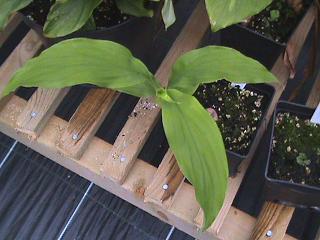
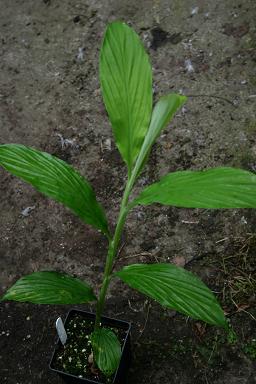
Lush green leaves - it is rather late to emerge in summer, and if it wasn't in the greenhouse, I don't think it would produce enough growth to survive the winter
(when it is dried off and brought indoors). Unfortunately it produced less growth each year and after a couple of years it failed to resprout in the spring. Writing in 'The Plantsman' in 2002, John Mood and Ida Theilade say of Zingiber citriodorum: "This spectacular Zingiber is unlike any ginger yet found in Thailand. Morphologically, the closest addinity in the genus is to be found in an Indonesian (Javan) species, Z. inflexum Bl. But even in this comparison, the primary likeness rests only in the inflorescence; both are green maturing to red, cylindric and Curcuma-like with slightly pinched, involute bracts. This Indonesian species also comes from high elevations and has a marked dormant period. (The first author has grown both species in Hawaii side by side). The beauty of this new species lies in its absolutely "clean" appearance, the maize-like appearance of the leaves, and in the light green inflorescence which, when mature, turns a brilliant, bright, shiny red. Z. citiodorum returns from dormancy in early May, normally corresponding to the start of the monsoon rains in Thailand. Within six to eight weeks, the pseudostems have reached their full size. Interestingly, during the plant's development the pseudostems can grow so rapidly that often the outer sheaths split up the edge. Sometimes inflorescences can appear during this development and are sheathed in leaves, but this does not appear to be normal. Plants in Hawaii flower in June and July. Each inflorescense produces two or three flowers per day, opening in the late afternoon and closing the next day around 3a.m. Once all the flowers have fallen, the bracts begin changing colour starting from the lowermost bract upwards and from the apex of each bract inwards. Initially the colour is dull red and green, but soon (by late July to early August) all the bracts become a brilliant red. In this final stage they have excellent shelf-life as a cut flower. The natural pollinators are not known but unlike many Zingiber species cultivated ex-situ, seed capsules have easily developed on nursery plants. The annual plant cycle ends in November-December when the plant goes dormant. This new species is being sold commercially in the United States as "Ching Mai Princess". Special note should be taken of the smell of the rhizome of this plant is more pronounced than that of any other ginger sampled over the years, including the primary ginger of commerce, Z. officinale. The rhizomes lemony smell is reminiscent of Eucalyptus citriodora leaves, but much stronger." |
|
| 12th September 2009 | ||