 |
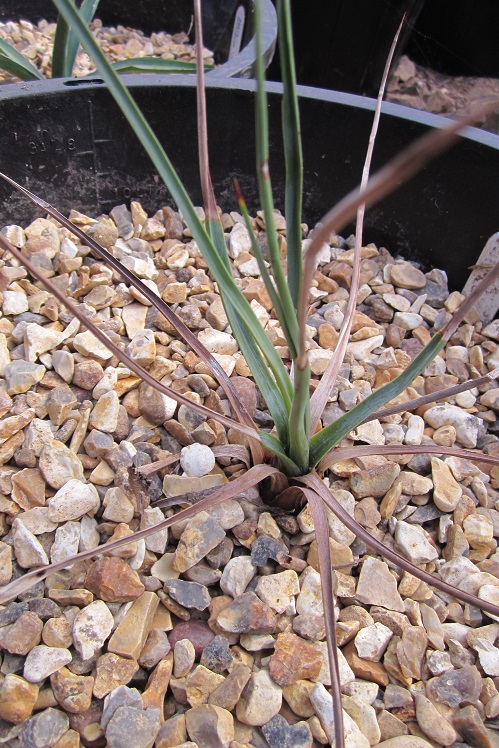
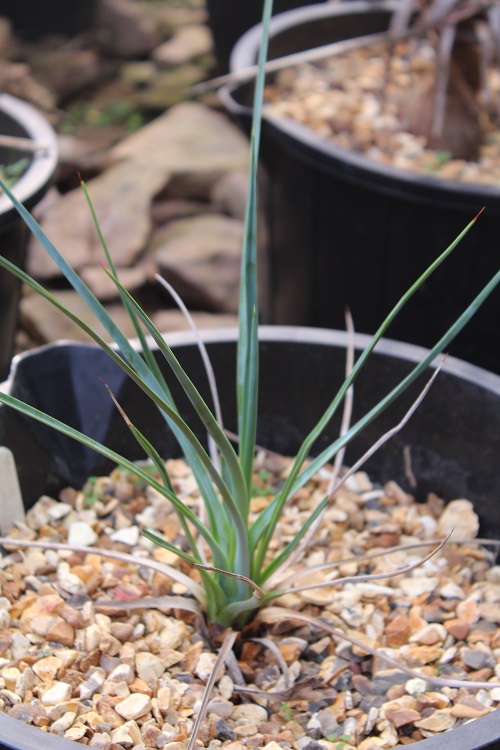
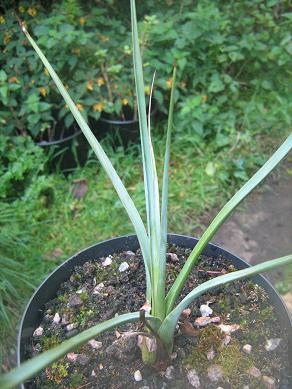
I have just been given this young plant. As it grows, I am hoping it will develop into a good blue leaved form. The species grows in California and western Mexico, and has been divided into a handful of subspecies. This one was grown from seed collected at Tehachapi in Kern County, California. In 1944 Lord Aberconway wrote in the Journal of the RHS: "Yucca whipplei can perhaps be considered the best of the species which it is possible to grow outdoors in this country. It is not only beautiful all year round for its recurved glaucous foliage, but has the most magnificent spike of pure white flowers bearing perhaps four or five times as many blooms as are found in the spike of any other species of Yucca that can be grown out of doors with us. The plant takes many years from seed before it flowers, but as it is always ornamental, the flower spike is most well worth waiting for. I send a photograph of two plants in bloomm at Bodnant which stand close together. These particular plants are growing on a raised border at the foot of a west facing wall, and there is, in winter, a frame of glass high up over them with a curtain in front which is drawn in very frosty weather. This curtain is, however, not there for the sake of the Yuccas, other plants of which grow and have flowered extremely well quite in the open, but for certain rather tender plants adjoining them. Indeed, coming as some do from above Monterey in California one would expect them to be hardy in Great Britain. These Yuccas are, however, doubtless helped by the fact that the glass overhead keeps off a great deal of the winter rain. The spike is ten feet or so high from the plant - the top six feet being covered with branchlets bearing the flowers. One of the spikes shown in the photograph has about 80 branchlets bearing 10-20 flowers each, say something of the order of twelve hundred flowers to the spike. The plants do not develop seed pods naturally in this climate, but if they are hand fertilised just a few pods develop on the spike. The great flowering effort is unfortunately an exhausting one and is apt to kill the plant, which in part accounts for its undeserved scarcity in cultivation." Trees and Shrubs online says: "A native mainly of southern California, in the coastal ranges south of San Francisco, extending inland to the borders of the Mojave desert; also reported from the Mexican State of Baja California and from Arizona. It was known to the Spanish missionaries in California, but was first described from specimens collected during Lt Whipple’s exploration for a railway route from the Mississippi to the Pacific in 1853–4. H. whipplei first flowered in Britain, under glass, with Mr Peacock at Hammersmith, in 1876. So far as is known, its first flowering in the open air in this country was with Mr Fletcher at Aldwick Manor near Bognor in 1910 (Gard. Chron., Vol. 51 (1912), H. whipplei is nearly hardy, and probably more plants have been killed by winter wet than by frost. At Bodnant in North Wales, where it has flowered several times, the plants are given no more than overhead protection in winter, to keep rain out of the crown. But all the recorded flowerings of H. whipplei in Britain are from gardens near the south or west coasts. Yuccas need warmth in late summer and autumn if they are to form their embryonic flower-spikes and it may be that H. whipplei needs more warmth than most other hardy species at that time. A plant at Borde Hill in Sussex vegetated for thirty years before flowering, which at least says something for its hardiness. At Bodnant, however, a plant from home-raised seeds set in 1944 flowered in 1951." |
|
| 12th October 2008 | ||