 |
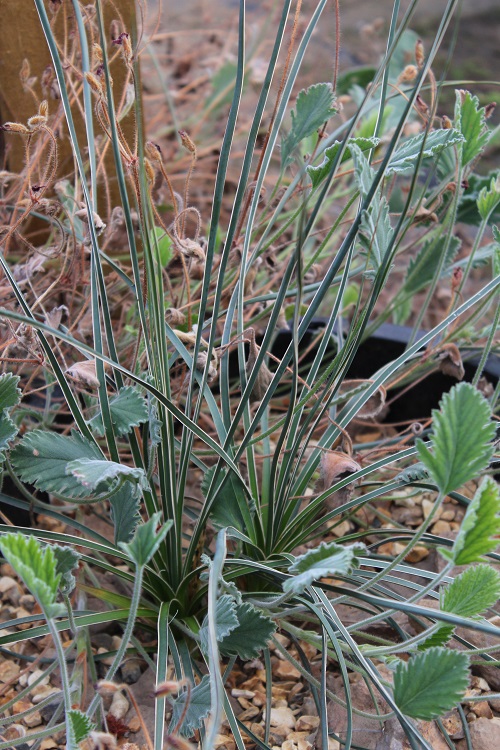
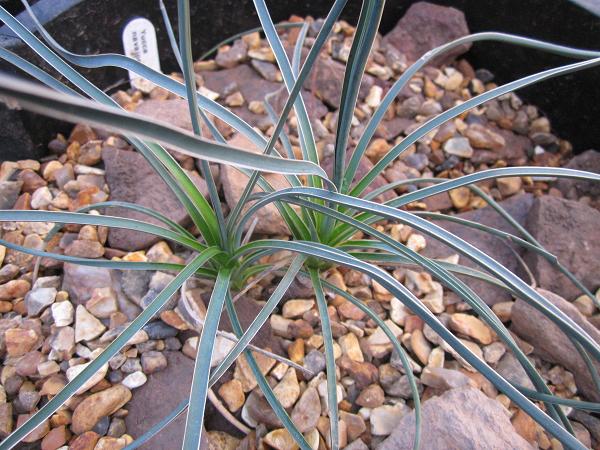
A dwarf growing species from the USA, this variety grows in Arizona and New Mexico so it should tolerate significant
freezing in winter, though it may not be quite so tolerant of winter wet. At present it is in the Agave House
but I would like to try one outside somewhere sunny. Growing well in very dry conditions (Pelargonium 'Splendide' if you were wondering). Succulentes.net says about Yucca baileyi: "Deep within the Navajo Nation — Dinétah, the ancestral homeland of the Diné people — a small, unassuming yucca has been woven into daily life and ceremony for centuries. Yucca baileyi, the Navajo yucca, does not tower like a Joshua tree or form giant colonies like its Colorado Plateau relatives. It is a compact, symmetrical rosette that rarely rises above knee height, yet it produces some of the largest flowers of any stemless yucca — pendant, creamy bells tinged with purple, up to 6.5 cm long, suspended on erect stalks that rise well above the piñon-juniper woodland floor. The Diné harvest its leaf fibers for weaving, brushes, and ceremonial items, and pound its roots into a rich, saponin-laden soap still used today for washing hair before ceremonies. For gardeners and collectors, Yucca baileyi — a species in the genus Yucca — offers exceptional cold hardiness, ethnobotanical depth, and a quiet elegance that rewards close observation." Spadefoot Nursery say: "The species epitaph, baileyi, comes from either Captain F. M. Bailey or Major Vernon Bailey, who collected yucca plants in the early 20th century. Captain Bailey collected in Tibet around 1913, and Major Bailey collected on Mount Wichita, Oklahoma around 1906. This species is native to Utah, Arizona, New Mexico and Colorado. Much of its native range is within the boundaries of the Diné Reservation, hence the common name "Navajo yucca." This is a short yucca reaching 3’ or a little higher, clustering to 6’ wide or wider. Solitary or with spreading rosettes, as many as 15. Flower spikes rise up about 5-6’ high with white flowers. Flowers occur in mid to late spring. Some populations of Yucca baileyi comprise compact colonies of semierect, branched plants instead of scattered, cespitose individuals. These populations are sometimes recognized as var. navajoa." |
|
| 17th January 2014 | ||