 |
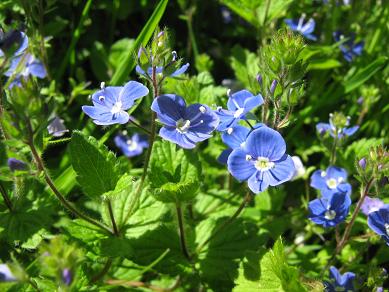
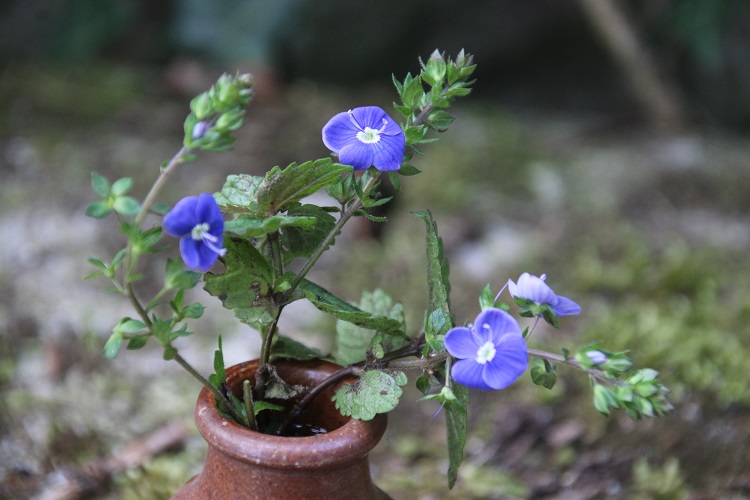
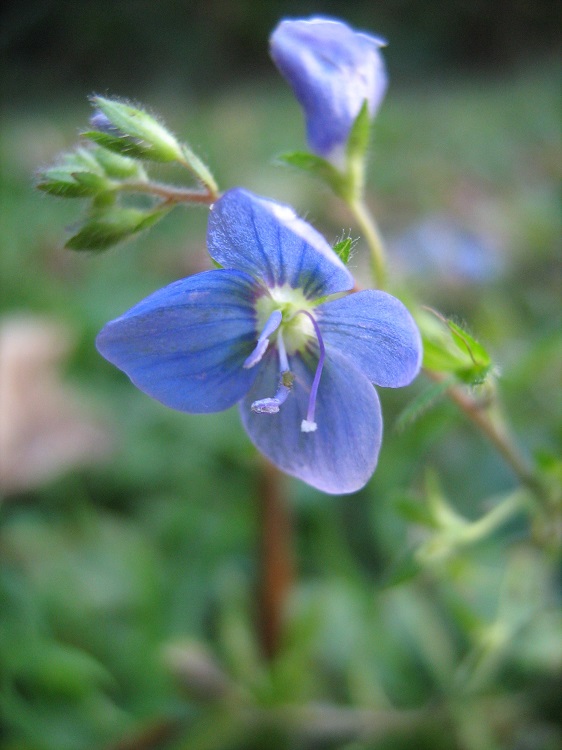
A common enough weed, but a delight in the long grass where I have been too lazy to mow.
If you ever need a justification for laziness then this is it, though for the record I would advise
you never waste time trying to justify it, just lie back in the shade and smile. Blue flowers are always interesting in the garden. There aren't very many that can be relied on to produce a show so it is good to have this common weed about the place (I am just as happy to have Pentaglottis sempervirens invading the shade border for the same reason). This year it has managed a display of flowers when the Plumbago is giving up for the year. Plants of the World online says: "The native range of this species is Europe to Siberia and Central Asia. It is a perennial and grows primarily in the temperate biome." The BSBI say: "This very familiar woodland margin, hedgebank, rough grassland, road- and lane-side, prostrate or decumbent, slender perennial, up to 30 cm high, Veronica species is immediately recognised by the two distinct rows of long whitish hairs along the opposite sides of the stem, which distinguishes it from the similar V. officinalis (Heath Speedwell) and V. montana (Wood Speedwell), which have hairs all round the stem (Garrard & Streeter 1983). This creeping, stoloniferous perennial is the most common and widespread terrestrial or aquatic Speedwell throughout the whole of B & I. While it is definitely most commonly found in areas of limestone geology and soils, Germander Speedwell achieves this degree of dispersal and presence through having a wide ecological amplitude, allowing it to crop up and persist in many different habitat types. Germander Speedwell had a reputation as a cure for jaundice "throughout Ireland", according to Vickery (2019), the flowers being boiled in a little milk and the infusion drunk. The same author records that in Norfolk the species was known as 'Sore-eyes' and the flowers were infused to make a soothing eye-bath. Vickery also mentions that a tea made from the species was esteemed a valuable remedy for indigestion and stomach pains in Guernsey. The origin of the name 'Speedwell', nowadays applied across the genus, really had its origins in the supposed medicinal properties of one or a few species of Veronica, such as V. officinalis. It meant the equivalent of 'prosper well', or 'go on well' or just 'get well soon', and may have had other connotations apart from health, perhaps some magical good luck wish or charm, such as 'good speed' or 'God speed', 'Wish-me-well', or 'safe travel' on a journey (Grigson 1955, 1987). |
|
| 25th November 2007 | ||