 |
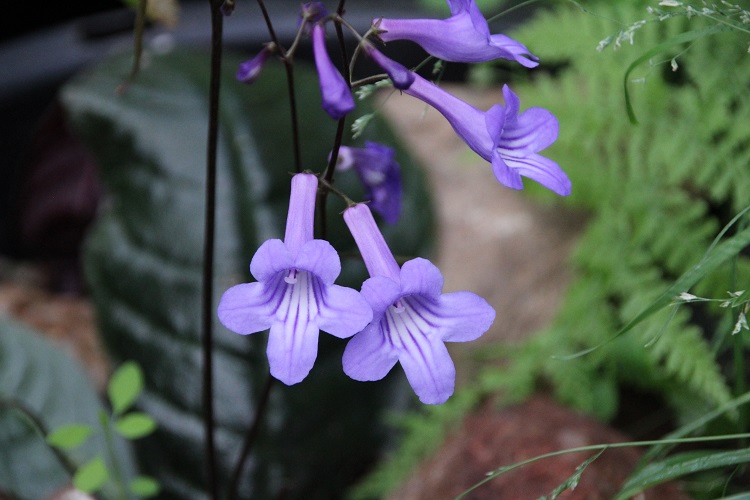
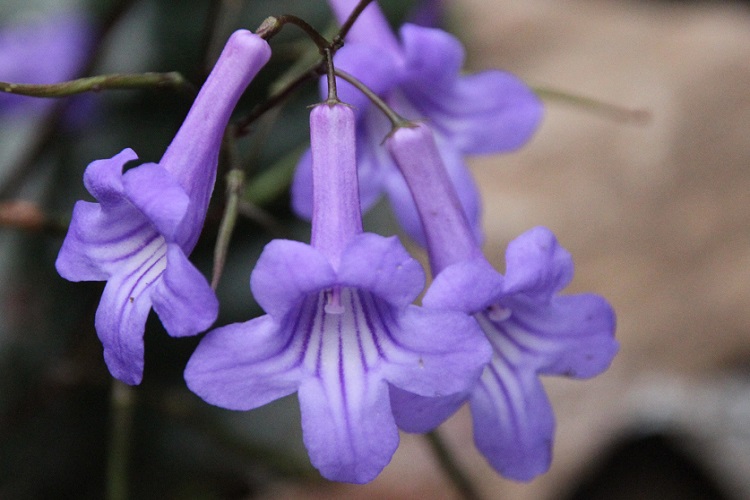
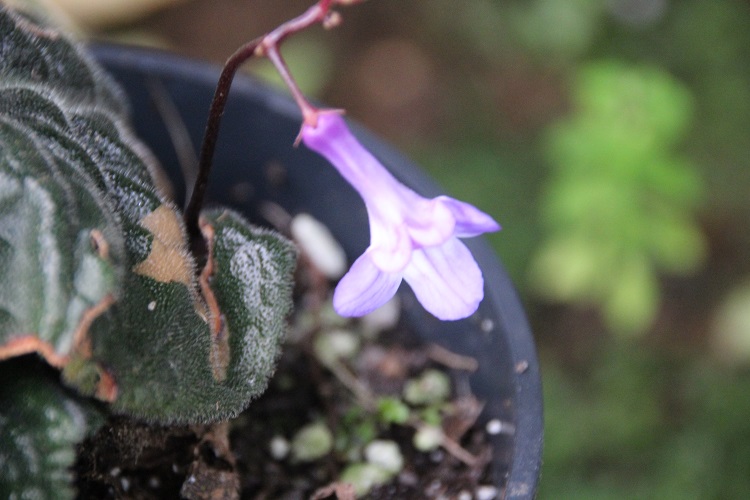
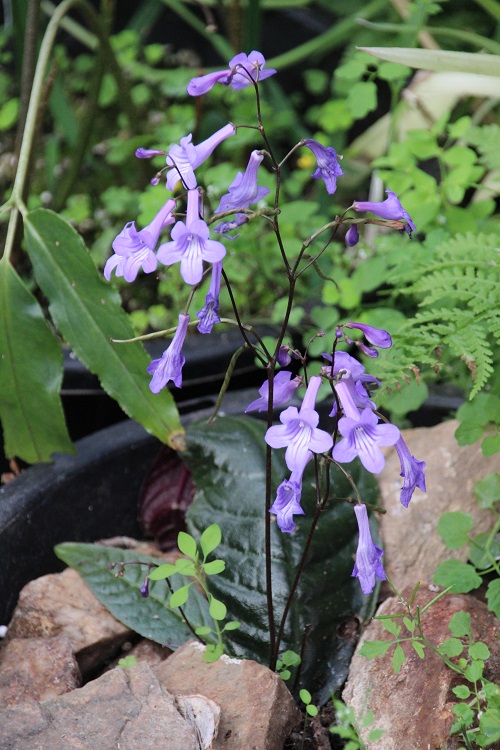
A large, leafy species. I had problems with it rotting until I planted it in the dry soil of the Agave house. It isn't happy, but it is happier. Unfortunately the Beast from the East cold spell in early 2018 killed it. Writing in the JRHS in 1991, Graham Yearsley says: "Most species are clump forming, but some such as Streptocarpus wendlandii, have only one huge leaf - 45-60cm (1 1/2 -2ft_ long and up to 15cm (6in) broad. The grey-green leaves have prominent veins and are covered with short hairs. Branched flower stems 15cm (6in) tall arise from the base of the leaves, and bear flowers of typical streptocarpus structure, pale blue with deeper blue stripes in the throat. Being so large, the leaves are easily damaged; it is best therefore, to allow plenty of space between the plants so the tips do not touch pot edges. Because of the leaf's large surface area there is much transpiration during warm weather and adequate watering is a must to avoid severe wilting. Cultivation should be the same as for other streptocarpus, and propagation is by seed sown in spring." Hilliard and Burtt say: "S. wendlandii was grown by Dammann's Nursery at Naples from seed sent to them by Medley Wood, then curator of the Natal herbarium, Durban. It was named in their catalogue of 1890 by C. L. Sprenger, in honour of Hermann Wendland of Hanover. About the same time it was introduced independently to Kew (Watson, 1894) and it quickly became widespread in cultivation. The species is apparently endemic in Ngoye forest near Eshowe, where it is widespread and generally grows on steep earth banks but is occasionally epiphytic. The forest is only some 9600 acres in extent. The stalk of S. wendlandii is always well-developed so that the big leaf is partly raised off the ground: the beautifully coloured underside is them visible because each half of the lower part of the blade is somewhaty ascending, forming a V about the mid-rib. Although there is some variation in the overall size of the flowers, the corolla tube is always short. This short and narrow tube readily distinguishes S. wendlandii fron its allies S. saundersii andS. molweniensis." |
|
| 1st September 2016 | ||