 |
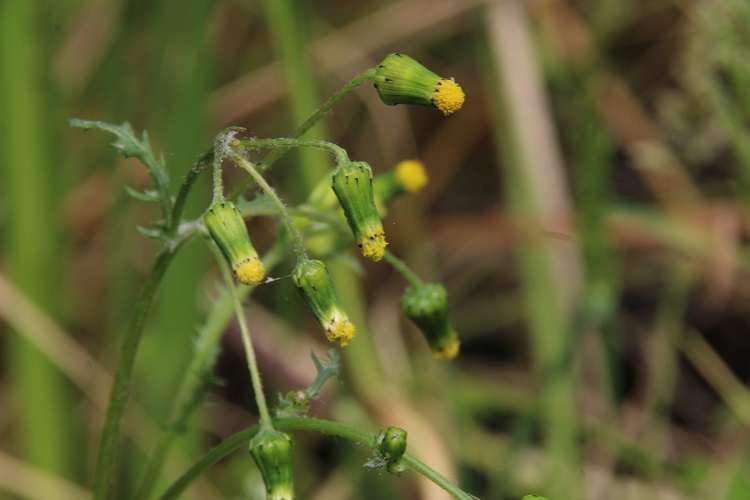
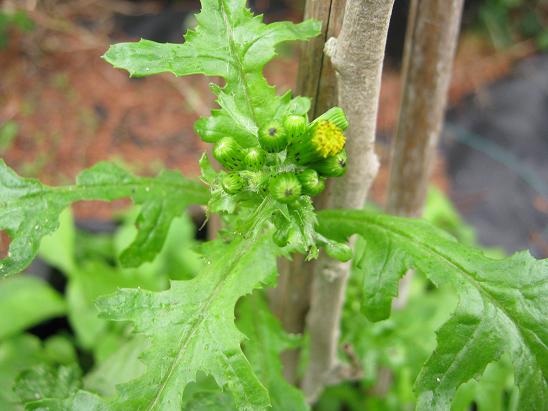
The genus Senecio is enormous and diverse and that is a good enough reason to include this,
the weediest of annual weeds. It doesn't grow here naturally, it prefers dryish disturbed soil
and is intolerant of wet bramble patches. On an expedition to a nursery in London I bought a couple of plants potted
in a mix containing a proportion of the local loam (they weren't quite growing in mud but the mix was clearly
an economical one). They were planted out, and in the rootballs a few Groundsel have germinated. It is so many years
since I have gardened with it that I am happy to let it seed where it will. If I believed for one moment that it would
establish here I would yank it out and stamp the life from its stinking stems, but it won't. Too wet. Plants of the World online says: "The native range of this species is Macaronesia, Europe to China and Arabian Peninsula. It is an annual and grows primarily in the temperate biome. It is used to treat unspecified medicinal disorders, as a poison and a medicine and for food." The Wildlife Trusts online say: "Groundsel is an annual weed of cultivated or disturbed ground, popping up along field edges, roadside verges and on waste ground. Branched stems lead to open clusters of yellow flowers that can be seen most of the year, and turn to white, fluffy seed heads. It is these seed heads that led to its Latin name, Senecio, derived from the word for 'old man' - pull the white, fluffy seeds from the flower head and they leave behind a bare, dotted 'scalp'". The University of Wisconsin-Madison says: " The origin of the common name is a derivation of the Anglo-Saxon groundeswelge, meaning ‘ground swallower,’ referring to how rapidly the weed spreads. It is a fairly inconspicuous little plant that is easily overlooked. |
|
| 8th January 2011 | ||