 |
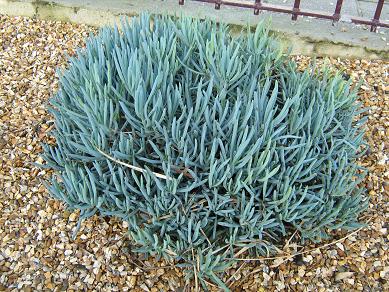
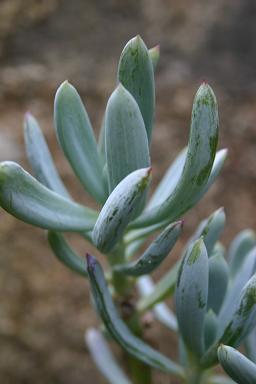
An odd succulent blue leaved daisy. I have yet to see if it is hardy enough to survive the winter in a cold greenhouse. I have since seen it growing outside in Falmouth, so I think it will survive under glass here. I might even try it in the garden. The genus Senecio has recently been split and this has become Curio repens. Plants of the World online says: "The native range of this species is Cape Prov. It is a succulent subshrub and grows primarily in the subtropical biome." Plantzafrica says: "Curio repens is a low, cluster-forming to drooping, leaf and stem succulent perennial from sandstone cliffs and rocky parts of the Cape Peninsula to Hermanus. The leaves, often crowded at the branch ends, are striking bluish pale green and have a resinous smell when damaged. Easily grown from cuttings or and best for dry, warm, Fynbos and Mediterranean gardens. Plants grow locally abundant, often in habitats difficult to reach. Widespread, well established in gardens and nurseries and consequently not threatened. Curio repens has been recorded in the Western Cape, from the Cape Peninsula in the west to Hermanus in the east, and also as far inland as the Simonsberg near Stellenbosch. The plants grow in rocky habitats and often on vertical quartzitic sandstone cliffs (all aspects) at altitudes of 10–1 000 m. Plants root in crevices, and on rock ledges, becoming drooping. Also sometimes seen on rocks close to the sea. The plant was first named Cacalia repens by Carl Linnaeus in 1767, moved to the genus Kleinia by Haworth in 1812, then to Senecio by Jacobsen in 1951. It was transferred to the new genus Curio created by Paul Heath in the journal Calyx in 1999. Curio was established by Heath for the group of succulents, previously in Senecio, distinguished by having an evergreen nature, with elongated, striated, succulent leaves and discoid flower heads lacking ray florets. The genus name Curio means ‘to lean’ pertaining to many species with a leaning or decumbent habitat. The Latin species name repens, meaning ‘creeping’, pertains to its creeping nature. According to Rowley (1994) it was introduced to Europe in 1710. Another synonym for Curio repens is Senecio serpens G.D.Rowley." |
|
| 13th April 2006 | ||