An article by Stephen Harris for the Oxford University Herbarium online says:
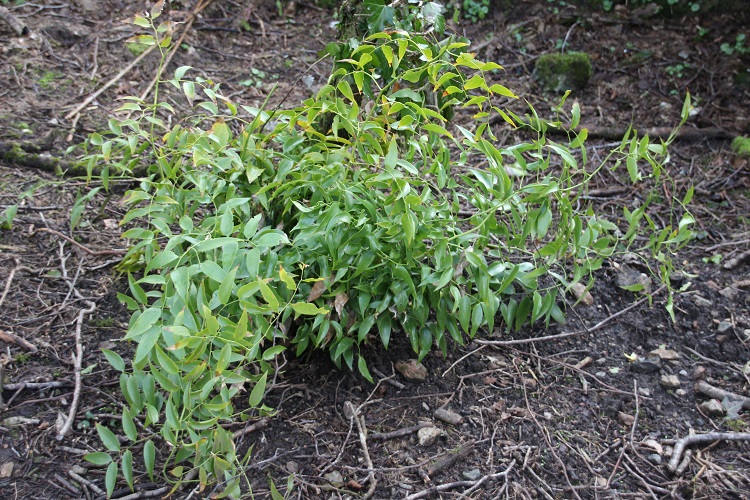
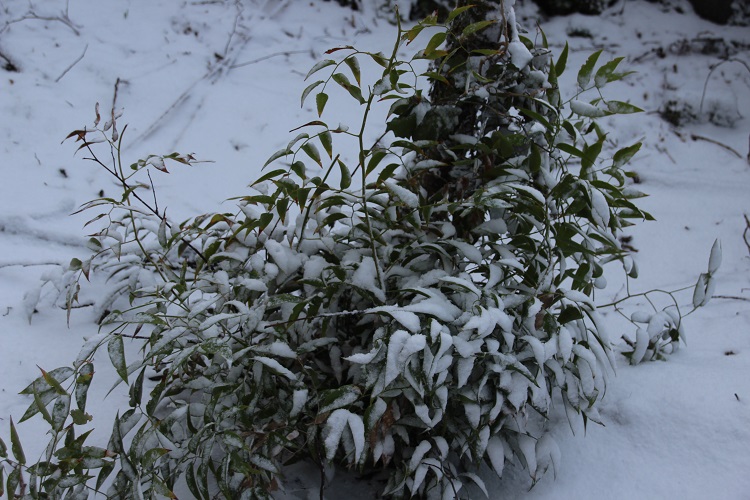
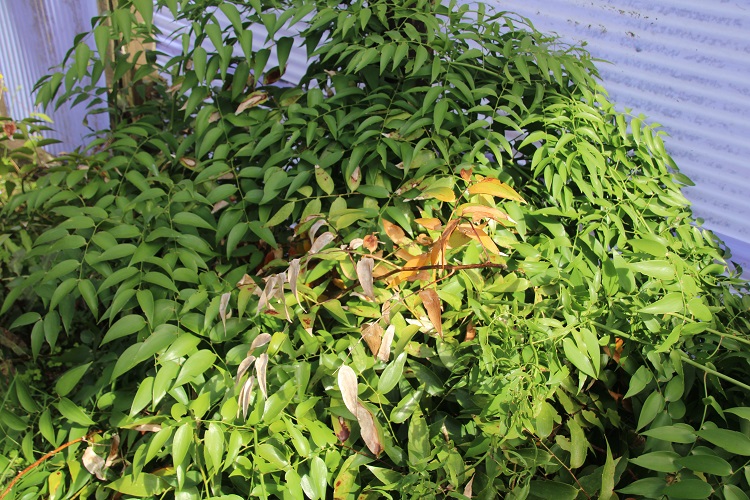
"The genus Semele contains one species; an endemic, evergreen, 'woody' climber reaching into the canopy of the laurel forests of the Canary Islands and Madeira.
However, the species' disjunct distribution, across volcanic islands, and curious morphology has led some botanists to recognise more than one species within the genus.
At first glance, Semele appears to have rows of broad, shiny, dark green, photosynthetic leaves on either side of an asparagus-like stem, at least when very young.
However, closer inspection shows the 'leaves' are flattened stems (cladodes). The true leaves are tiny, brown, non-photosynthetic, scale-like, papery structures at
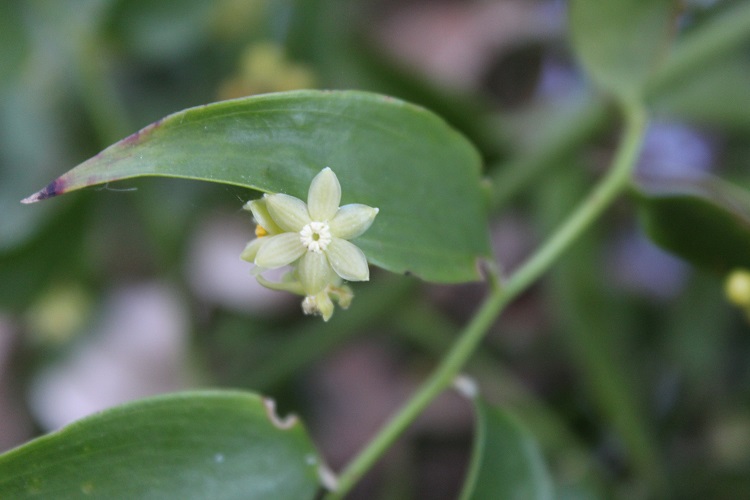
the base of the cladodes. The clue to the cladodes being stems rather than leaves comes from the clusters of creamy-white flowers along their margins;
leaves do not usually bear flowers. Semele plants are monoecious, that is they have separate male and female flowers on the same individual
(hence the species name which means 'male-female').
The plant's unusual morphology, abundant flowers and the pea-sized, orange-red berries has made it a popular, if rarely grown, glasshouse curiosity in Britain
since the early eighteenth century. For example, in Oxford University Herbaria there is a specimen of Semele that illustrates the complex connections that bound
naturalists during the eighteenth century. The specimen comes from the collection of Charles Dubois (1658-1740), cashier-general of the East India Company and
a prolific hoarder of herbarium specimens. Dubois got the specimen from the Reverend William Stonestreet's (d.1716) collection, who in turn collected the plant
in the Royal Gardens at Hampton Court Palace.
The seeds that gave rise to the regal plants were probably collected by the Scottish surgeon and naturalist James Cuninghame in La Palma, Canary Islands in early 1698.
Cuninghame was on his way to China, when he made the first significant botanical collections in Macaronesia. By 1713, James Petiver (c.1665-1718), the London apothecary
who acquired Cuninghame's plant specimens was able to boast that 'Mr James Cunningham, that diligent Botanist, brought me this strange Plant from the Island of Palma,
with ripe Fruit on the edges of its Leaves, which I sent to Hampton Court, where it has grown ever since'.
Cuninghame's plant was formally placed in the genus Ruscus by Carolus Linnaeus in 1753 based on superficial similarities to a widespread European species,
butcher's broom (Ruscus aculeatus L.). However, more detailed, mid-nineteenth-century investigations showed the Macaronesian plant was distinct from Ruscus;
a view supported by modern DNA analyses.
|